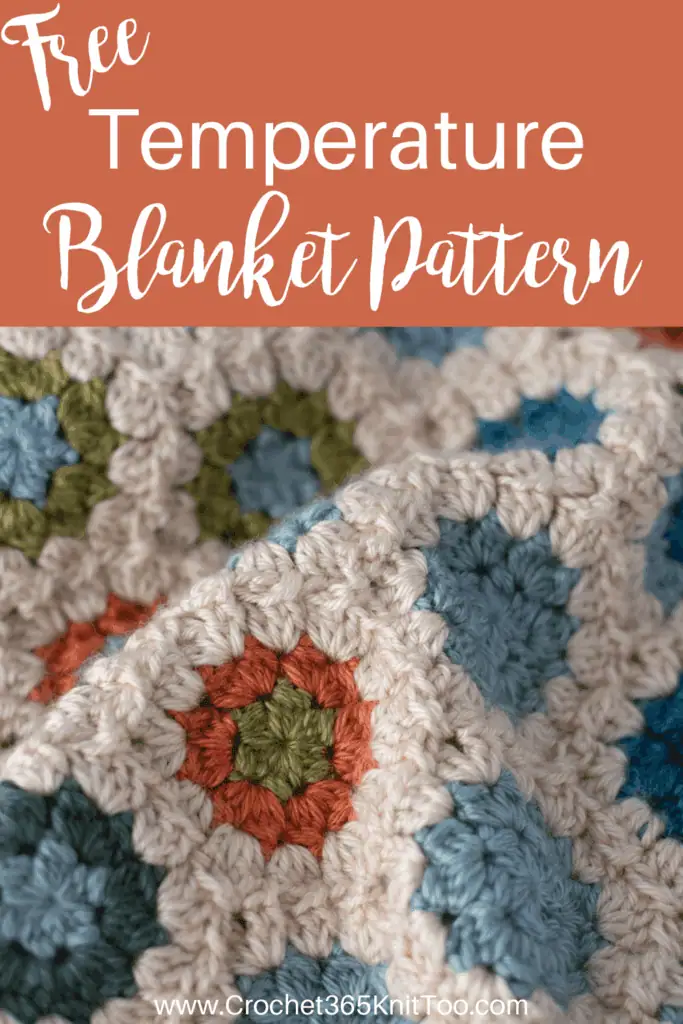
Crochet Temperature Blanket
This post may contain referral/affiliate links. Please read my disclosure for more info.
Have you’ve ever dreamed of making a crochet temperature blanket but worried it would turn out way too long, awkwardly sized or impossible to plan? Temperature blankets are a lovely way to record a year in yarn, but patterns often fall short when comes to sizing and layout. Meet the perfect solution in this beautiful temperature afghan!
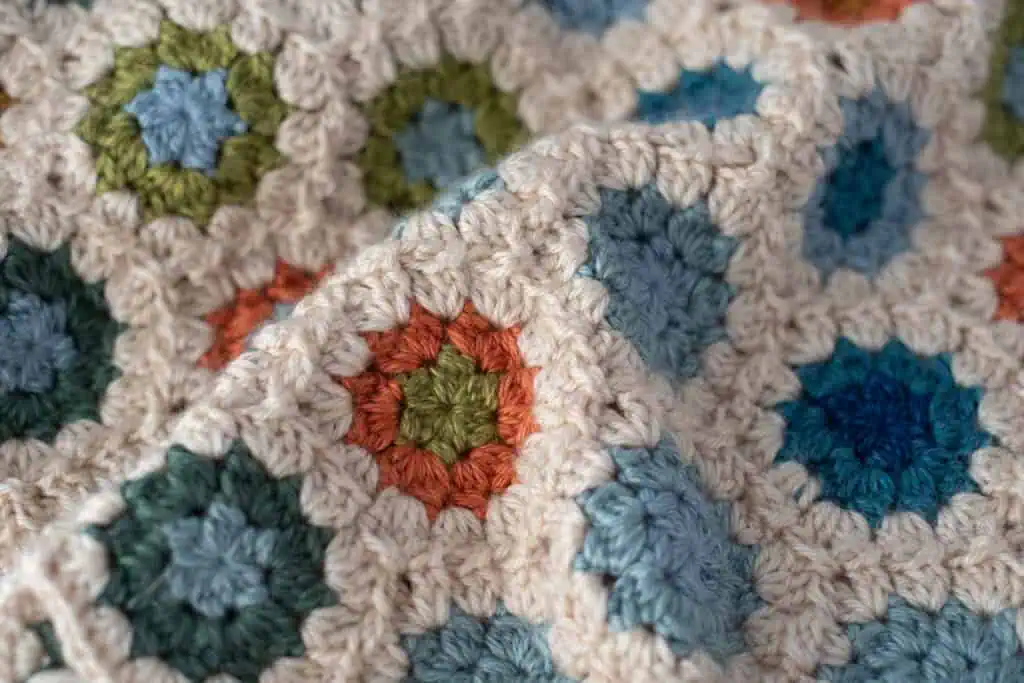
I’ve been wanting to make a temperature blanket for.. well.. years. I love the idea of quietly stitching each season day by day and watching a life lived play out in yarn
But while this all sounds lovely in theory, the logistics always got me. Often people will work a ‘row’ for each high temperature of the day. But even in the smallest single crochet stitch possible, this turns into a monster sized afghan.
As in 7 feet or more. I mean do YOU want an afghan THAT long? I sure don’t!
Some people will split the year in half, but that didn’t feel right to me either. And granny square afghans didn’t work well either because dividing 365 or 366 days into a grid of an equal number of squares doesn’t math out.
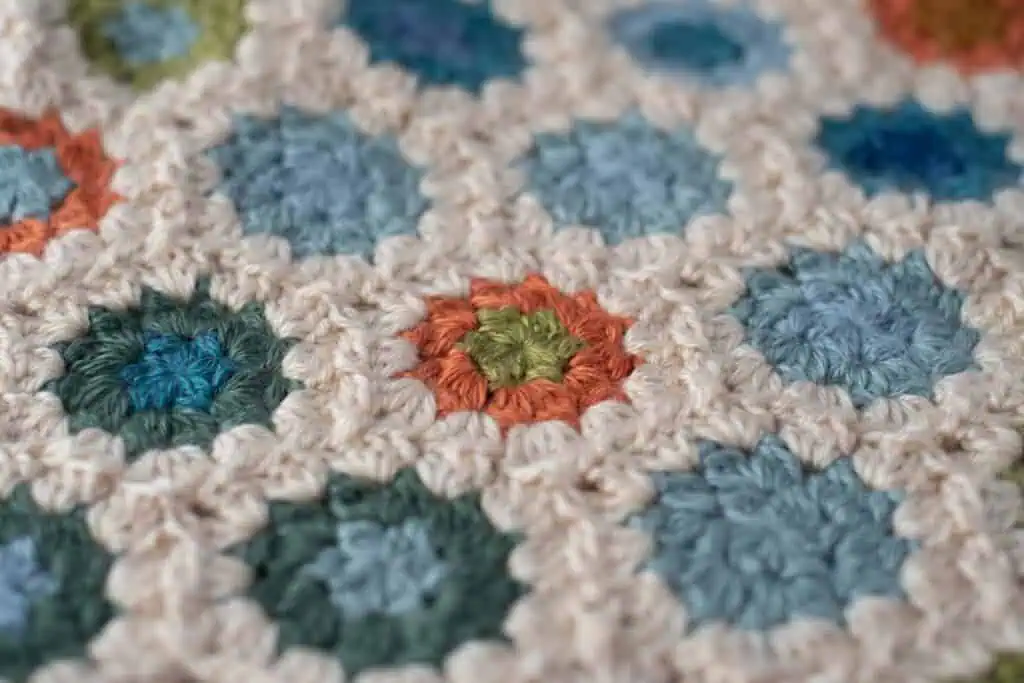
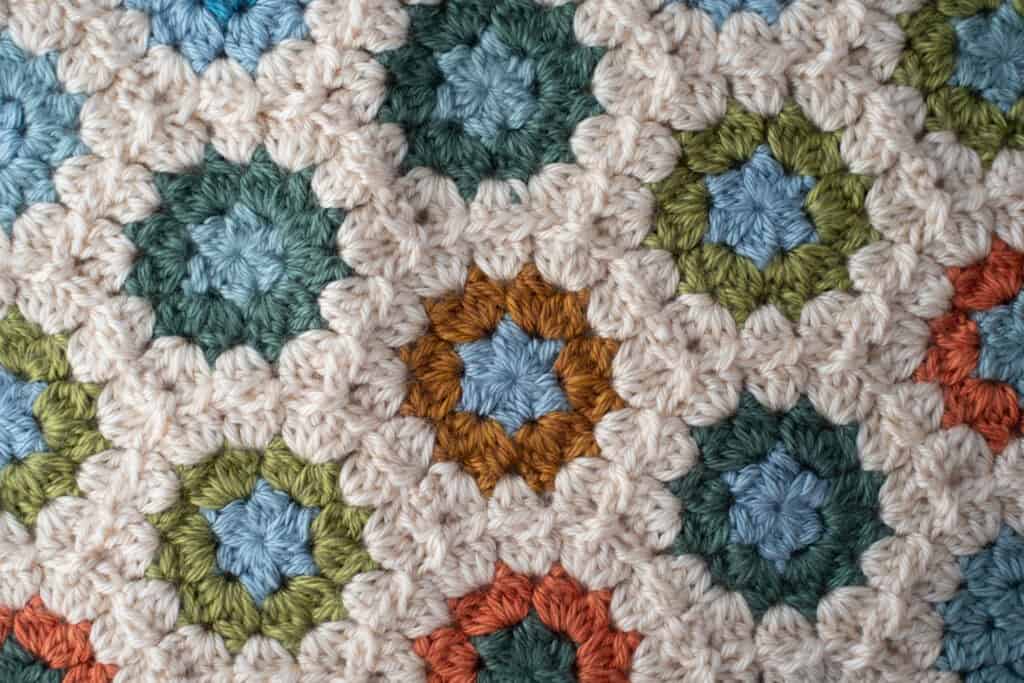
The hexagon design I settled on solves ALL these problems and allows you to record both the high and the low temperature each day in one motif and then join ALL the days together into an afghan that is throw-sized, perfect for your couch. PLUS there is a 365-day layout and a 366-day layout (for leap years).
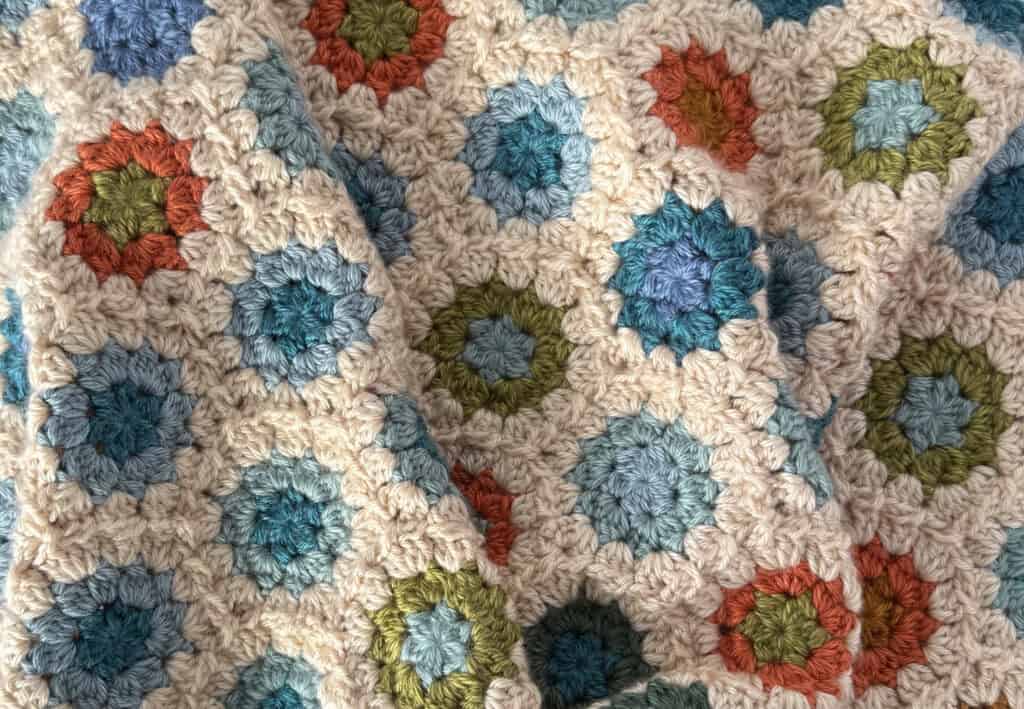
Joined hexagons present their own unique challenges. Full hexagons joined together leave a beautiful scalloped edge on two edges but the two other edges end up with half hexagon cut out areas which I’m personally not a fan of.
In many hexagon afghans the scalloped edge is at the top and bottom and maybe some fringe is added and then half hexagons fill in those spaces at the side. However, this layout won’t work with a 365 or 366 day layout.
So I’ve rotated the design and I’m oh so happy with the end result. The top and bottom row are worked in half hexagons, leaving us with straight top and bottom edges and both sides have that pretty scalloped edge. I don’t mind not giving the first and last days of the year less “space” (ie a half hexagon vs a full hexagon) since it’s usually darn cold here in Michigan during that time.
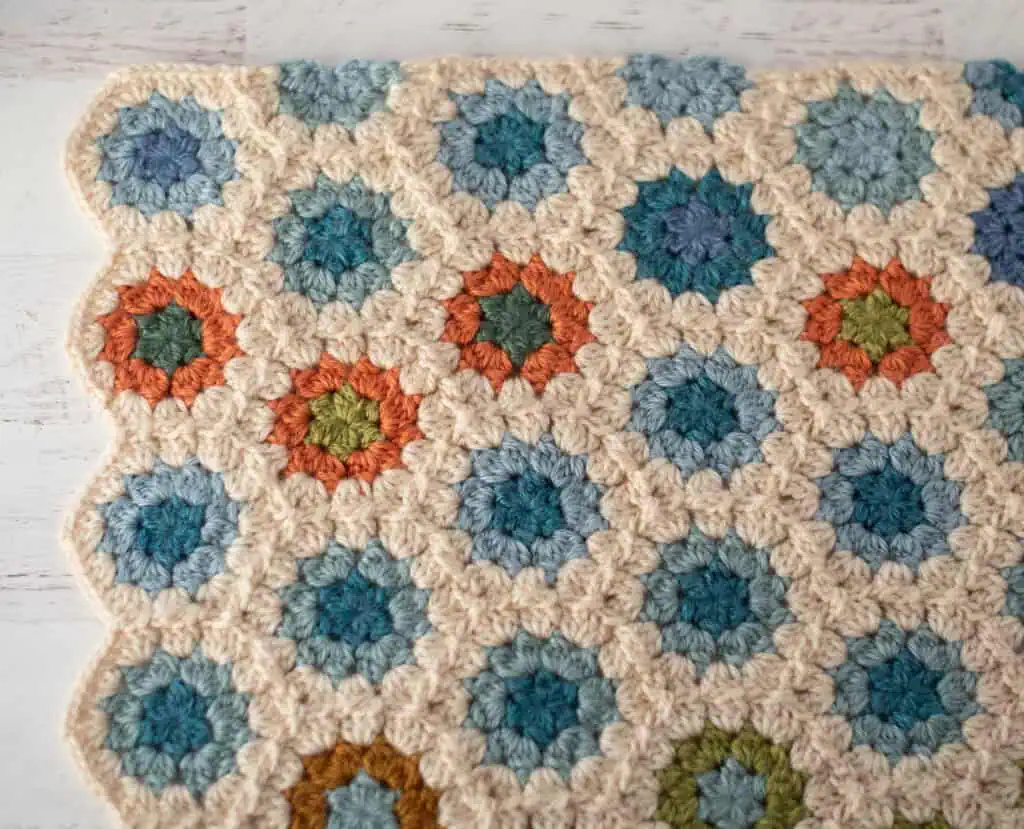
And I completely love that this layout will work with a slight adjustment for 366-day leap year as well!
Purchase the beautifully formatted
AD-FREE PDF DOWNLOAD + Bonus Worksheets
- Layout for 365 or 366 day year
- Temperature Keys
- Daily Trackers
The hexagon itself is an easy 3-row pattern with the 3rd row joined as you go to adjacent hexagons. The most challenging part of the afghan is keeping track of where you are as you are joining the hexagons.
Be sure to carefully read through the entire post so you understand how the blanket comes together.
Temperature Blanket
Materials
- Lion Brand Heartland, size 4 worsted weight, 100% acrylic, 251 yds/230m per 5oz/142g skein (try Herrschners, Amazon or Lion Brand)
- 9.5 Skeins Acadia (Ivory) [approximately 2,380 yards total]
- 1 or more skeins for each color. Quantity needed will vary based on weather (See planning your afghan section). I used the following colors: Olympic, Carlsbad Caverns, Glacier Bay, Voyageurs, Congaree, Rocky Mountains, Haleakala, Bryce Canyon, Gateway Arch, Yosemite, Badlands and New River Gorge.
- US G+7/4.50 mm crochet hook
- Stitch markers to keep track of rows
- Tapestry needle and scissors
Resources and tutorials you may find helpful in following this pattern: Crochet Abbreviations, US to UK Crochet Conversion Chart. Find links to stitches on the “Tutorial” menu: Getting Started will show basic stitches used in many patterns and Crochet Stitch Dictionary shows our growing collection of crochet stitch tutorials.
Gauge:
The inner circle (rounds 1-2) of the hexagon measures 2.25” in diameter. However, gauge is not imperative in this pattern. A slightly thicker worsted weight yarn may measure slightly bigger. See Planning Your Afghan Section for more information.
Resources and crochet tutorials you may find helpful in following this pattern: Crochet Abbreviations, US to UK Crochet Conversion Chart. Find links to stitches and basic crochet skills on the “Tutorial” menu: Getting Started will show basic stitches such as the slip stitch, single crochet, double crochet stitch and chain stitch used in many patterns and Crochet Stitch Dictionary shows our growing collection of crochet stitch tutorials.
Crochet Abbreviations:
- ch = chain
- dc = double crochet
- sl st = slip stitch
- st = stitch(es)
Special Stitches:
This project uses cluster stitches that are worked similarly. A basic Cluster Stitch tutorial follows the stitch descriptions.
2dcc (2 double crochet cluster): *yarn over, insert hook in stitch, yarn over and pull through stitch, yarn over and pull through first 2 loops on hook*. Repeat from * to * once in same st. There are now 3 loops on hook. Yarn over and pull through all 3 loops on hook.
3dcc (3 double crochet cluster): *yarn over, insert hook in stitch, yarn over and pull through stitch, yarn over and pull through first 2 loops on hook*. Repeat from * to * two more times in same st. There are now 4 loops on hook. Yarn over and pull through all 4 loops on hook.
Finished Temperature Afghan Size
Afghan measures 49” x 64”
Planning Your Temperature Blanket
This throw sized blanket has motifs (hexagon or half hexagon) where each motif represents one day. There are two layouts provided: One for a 365-day year and one for a 366-day year (leap year). There are no “extra” motifs needed to fill in; the 365-day layout has exactly 365 motifs and the 366-day layout has exactly 366 motifs.
The afghan is comprised mostly of hexagons. The very first row and the last row are made of half hexagons. This results in an afghan with straight edges on the top and bottom and scalloped edges along each side. Hexagons are joined using a join-as-you-go method working from the top down, and left to right.
You may work your afghan on a calendar year starting with January 1 or a milestone year such as a birth, marriage or retirement year instead.
Each hexagon starts as a 2-round motif. Round one is for the low temperature of the day. Round two is for the high temperature of the day. Alternatively, you may choose to only record one temperature (usually the high temperature) each day and thus both round 1 and round 2 would be worked in the same color.
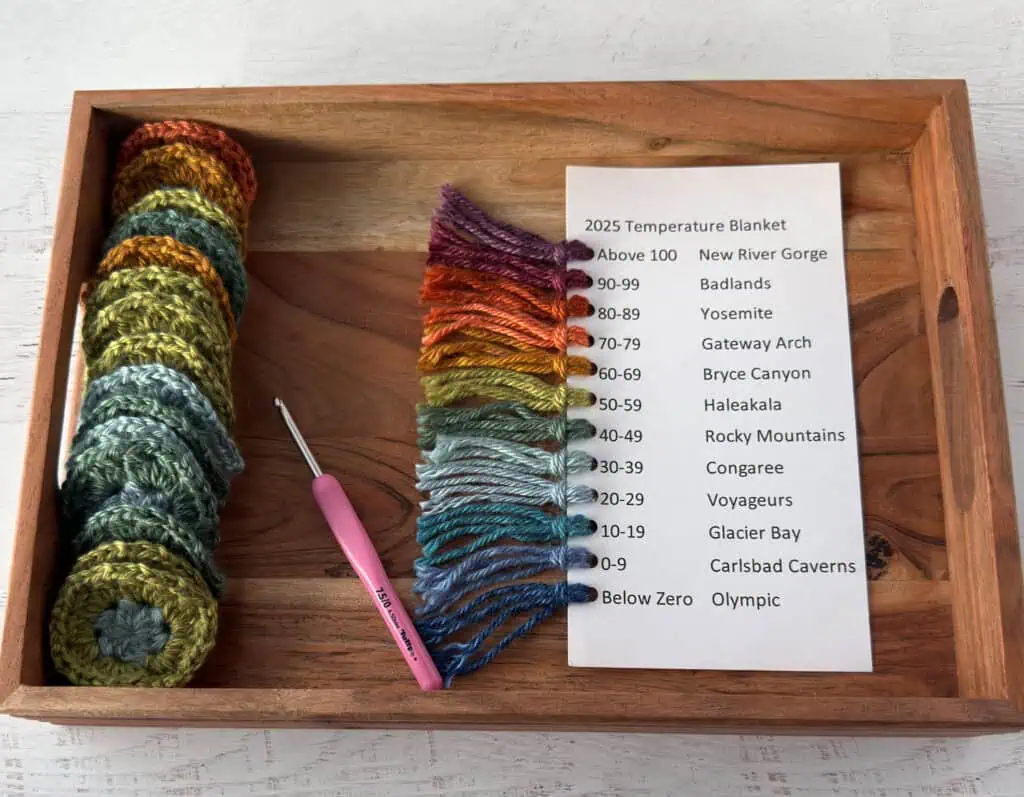
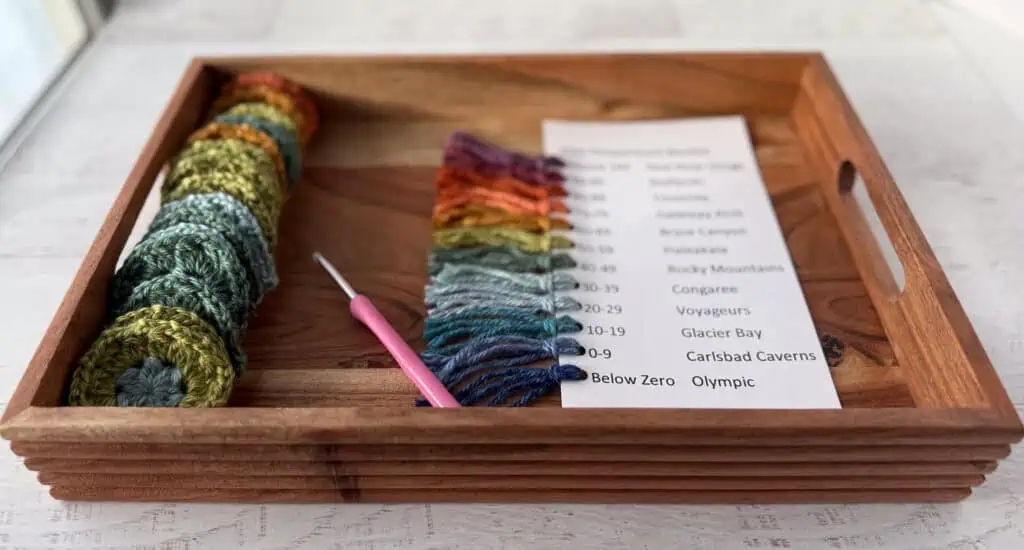
Start by creating a temperature chart. I live in the U.S. where we record temperature by Fahrenheit. I recorded my temperatures in increments of 10. At the low end, was anything lower than 0 degrees. At the top end, was anything higher than 100 degrees. This gave me 12 colorways. However, depending upon the year and your climate what you end up using might be different than planned. For instance, when I made my blanket, we never had a day that hit 100 degrees or higher so I never used my planned “highest” temperature color!
Timeanddate.com is an excellent website for finding the high and low temperatures for each day because the site enables going back to earlier dates.
You also might find that you use more than 1 skein for a particular color if your climate loves to live in that temperature zone. This can be a challenge at the start since most of us do not want to over-buy yarn. Since this blanket is worked in hexagon motifs, a dye lot difference will not be noticeable in the project if you find you need to purchase an additional skein later.
Finally, a word on sizing. I’ve provided the gauge of the first 2 rounds of my hexagon and the finished measurements of my afghan. However, we all crochet differently from one another and even day to day. If we having a stressful day, our work might be tighter vs a very relaxing day. You may find that your gauge is not exactly like my gauge. You might even find that not all of your circle motifs (rounds 1 & 2) match each other. This is ok. The pattern is very forgiving for these slight variances.
The afghan is sized to be a throw, using Lion Brand Heartland yarn which is a worsted weight (but somewhat lightweight) yarn. If you use a slightly thicker worsted weight yarn, your overall afghan might turn out bigger, but it will still be an appropriately nice sized throw.
Before purchasing yarn for the main background color (especially if you using a different yarn or have a different gauge), work a test hexagon with your chosen yarn. Leave a 6” tail before starting round 3 and leave a 6” tail at the end of round 3. Unravel the yarn used for round 3 and measure it. Times this by 365 (or 366) days to get the total quantity of yarn you need. Add a little bit to this for error and purchase THAT quantity for your background color.
Note that the pattern does not have a border. Should you wish to add one, this will require more yarn.
Important Assembly Note Before Starting
It’s important to understand how you will be crocheting and assembling the first few rows before you start your first motifs.
The bulk of the afghan is joined with the Join-As-You-Go method, one hexagon at a time. However, the first 3 rows are joined a bit differently. Below is a sample of the first 4 rows in the 365-day layout. Note that your row will actually be much wider; this is just a sample of how the starting hexagons are configured. Refer to your 365 (or 366)-day layout for actual assembly.
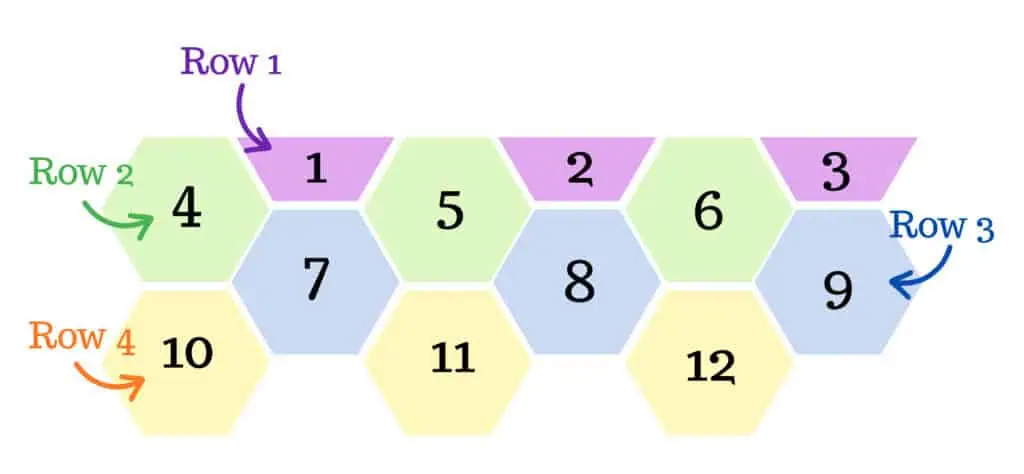
Step 1: Row 1 represents the first days of the year. Crochet half hexagons for these first days, set them aside until step 4 and keep them in order. For a 365-day year you will have 8 half hexagons in row 1. (For a 366-day year you will have 9 half hexagons)
Step 2: The very 1st hexagon in row 2 is the only hexagon that is worked with all 3 rounds without joining to another one. The rest of the hexagons work round 3 in the joining process. Work the first hexagon of row 2 (all 3 rounds). Then work rounds 1-2 for the remaining hexagons in row 2. Set these aside and keep them in order. There are 9 hexagons (365-day layout) or 8 hexagons (366-day layout) in row 2.
Step 3: In Row 3 we start joining as we go. Note that you are ONLY joining Row 3 hexagons to row 2. (The half hexagons from row one are joined in step 4.)
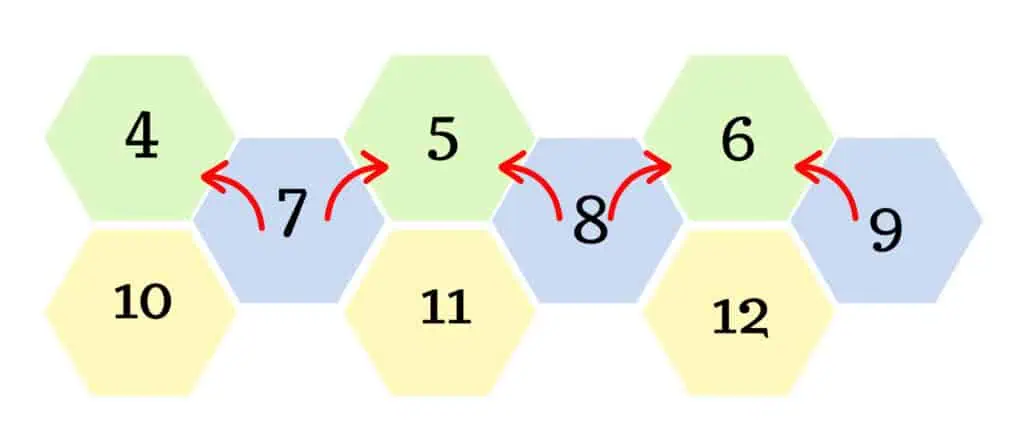
Step 4: Next join the row 1 half hexagons into place above row 2, using the join-as-you go method. You will attach on 3 sides to hexagons in rows 2 and 3.
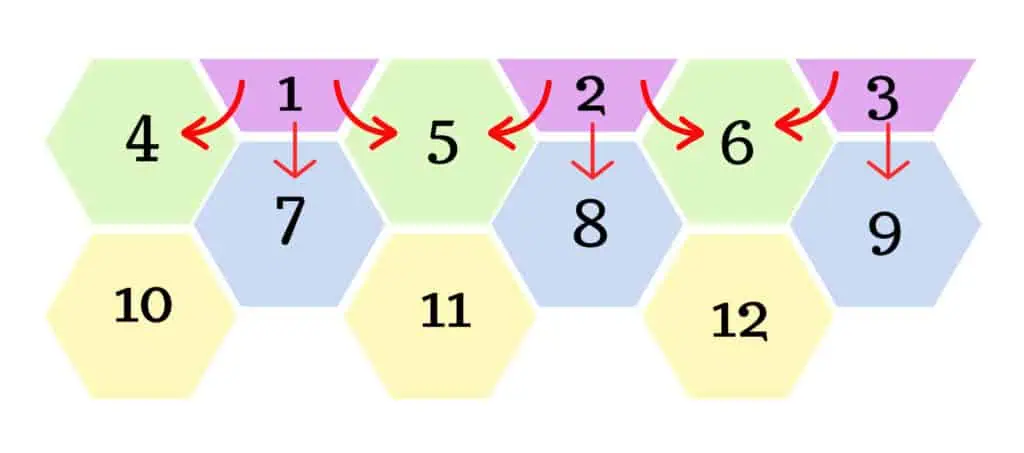
Step 5: From here on out, crochet rounds 1 & 2 following the hexagon pattern for each day and then crochet round 3, joining as you go to the surrounding hexagons in the space created by the prior row. The rows alternate between 8 and 9 hexagons each.
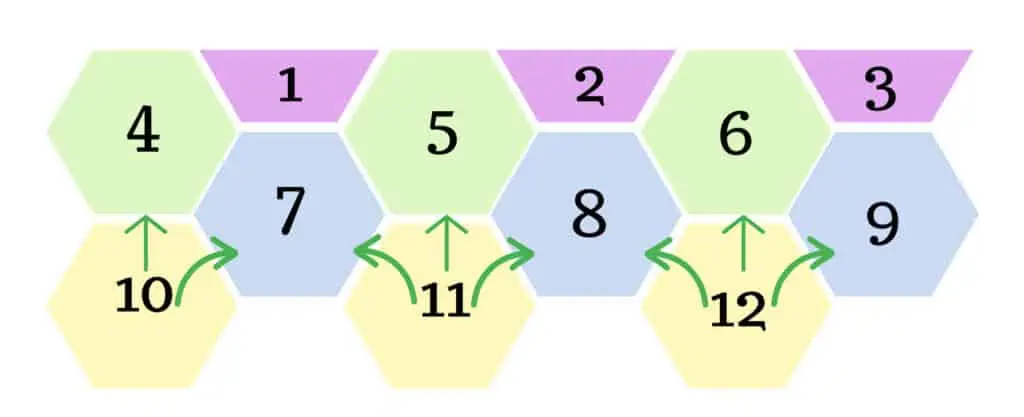
You may find it helpful to use stitch markers to mark the starting point for joining a daily hexagon to the afghan.
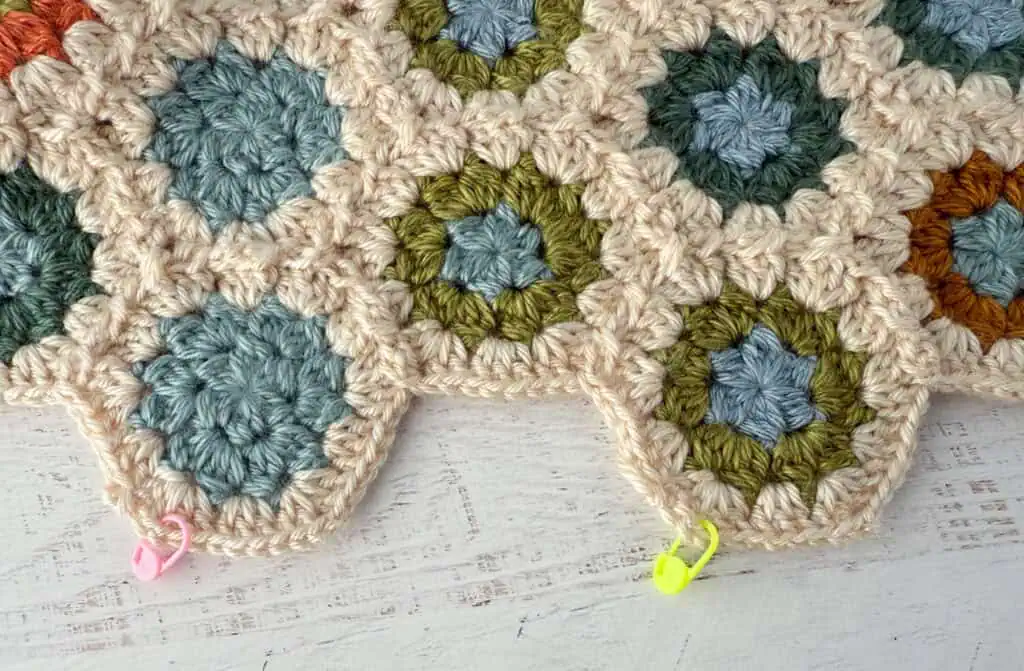
Step 6: The final row of the afghan is in half hexagons and joined the same way as in Step 4.
Specific instructions for the join-as-you-go method for both the hexagon and half hexagon rows follow the directions for the hexagons and half hexagons.
Temperature Blanket Pattern
Let’s dive into the actual pattern!
Crochet Hexagon
Special note: It’s a good idea to make a practice hexagon of the 3 full rounds so you understand the process before moving on to working half hexagons or the join-as-you-go process. Technically the only time you are working a full 3-round hexagon without joining to anything is the first hexagon of row 2 (see above). This would be day 9 in a 365-day year or day 10 in a 366-day leap year. If you know the temperatures for that day, go ahead and make your practice hexagon in those colors. Otherwise, just make a practice hexagon so you understand the process.
With first color, make a magic ring
R1: Work all in the magic ring: Ch 2, (2dcc, ch 1), [(3dcc, ch 1)] 5 times. Sl st to top of starting ch-2 to join. Fasten off 1st color. (6 clusters)
R2: With 2nd color, sl st to a ch-1 space, then ch 2, (2dcc, ch 2, 3dcc, ch 2) in the same space, (3dcc, ch 2, 3dcc, ch 2) in each remaining ch-1 space around. Sl st to top of starting ch-2 to join. Fasten off.(6 sets of 2 clusters)
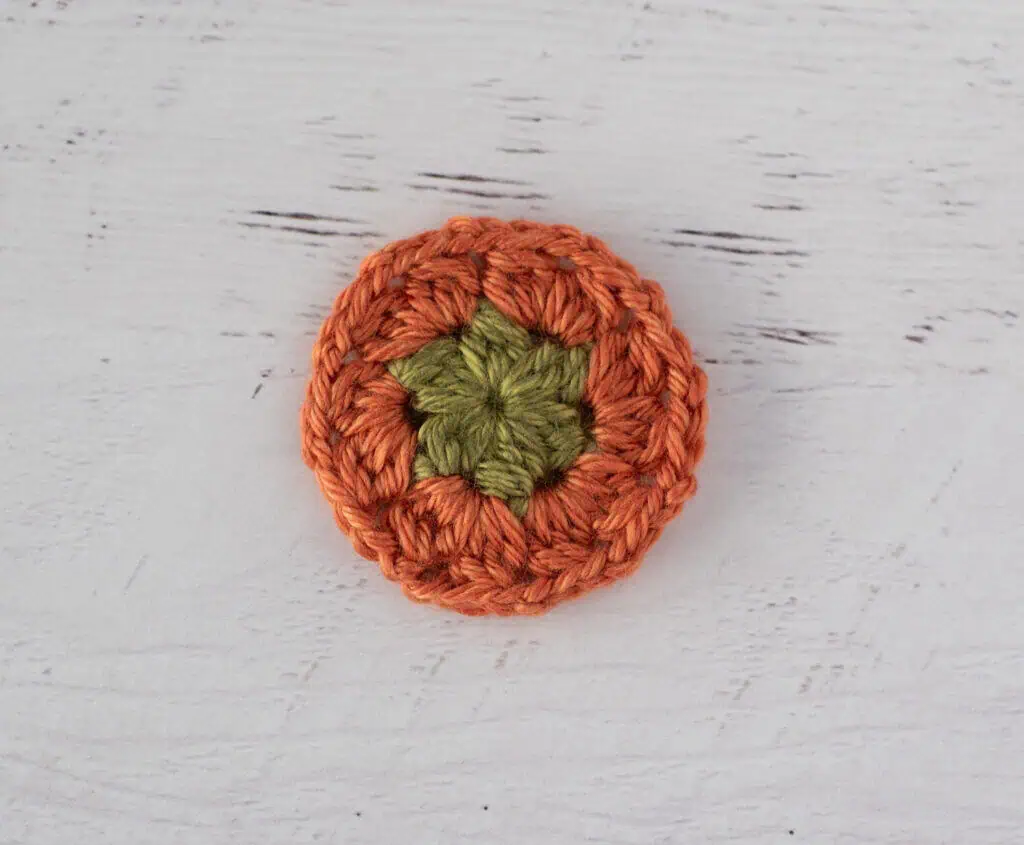
Reminder: Round 3 is worked as written for the first full hexagon in row 2 of the blanket. However, the instructions still apply when joining as you go; you’ll just be incorporating the joining as part of round 3.
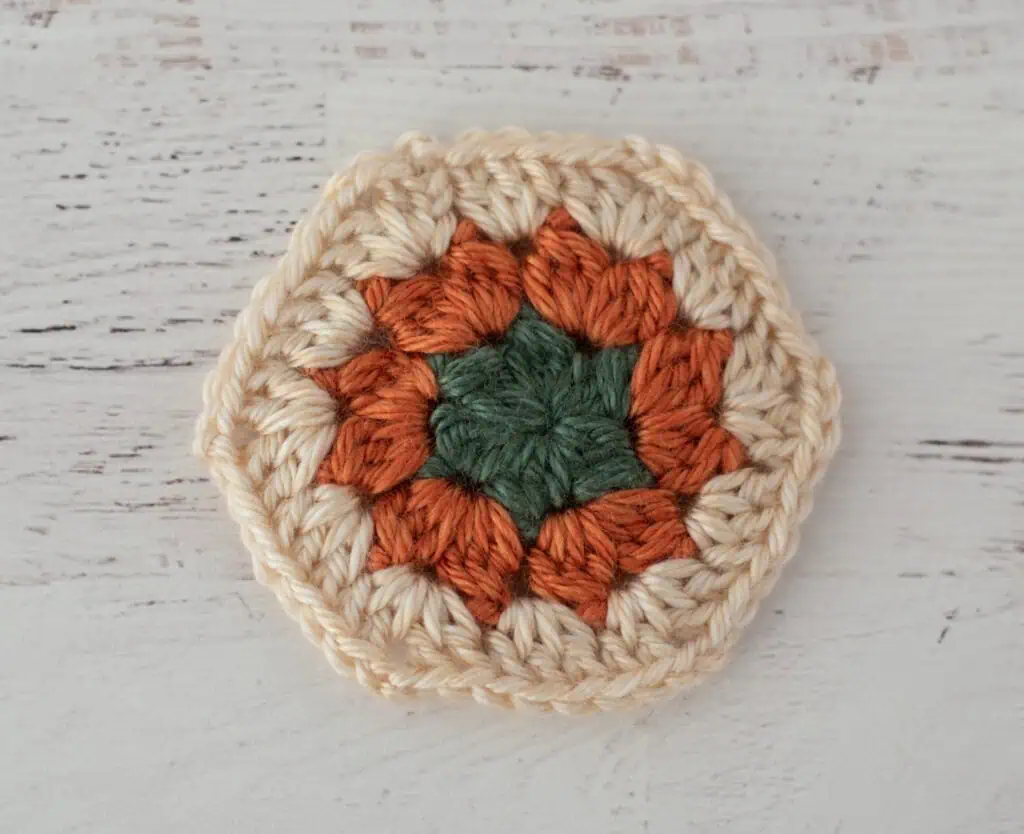
R3: With main yarn color, sl st to a ch-1 space (this will be between a cluster set), then [ch 3 (counts as a dc), dc, ch 2, 2dc (corner made)] in same sp as join, 3dc in next space, *(2dc, ch2, 2dc) in next space, 3 dc in next space. Repeat from * around. Join with slip stitch to top of starting ch-3. Fasten off, leaving a long strand for joining.
Crochet Half Hexagon
With first color, make a magic ring
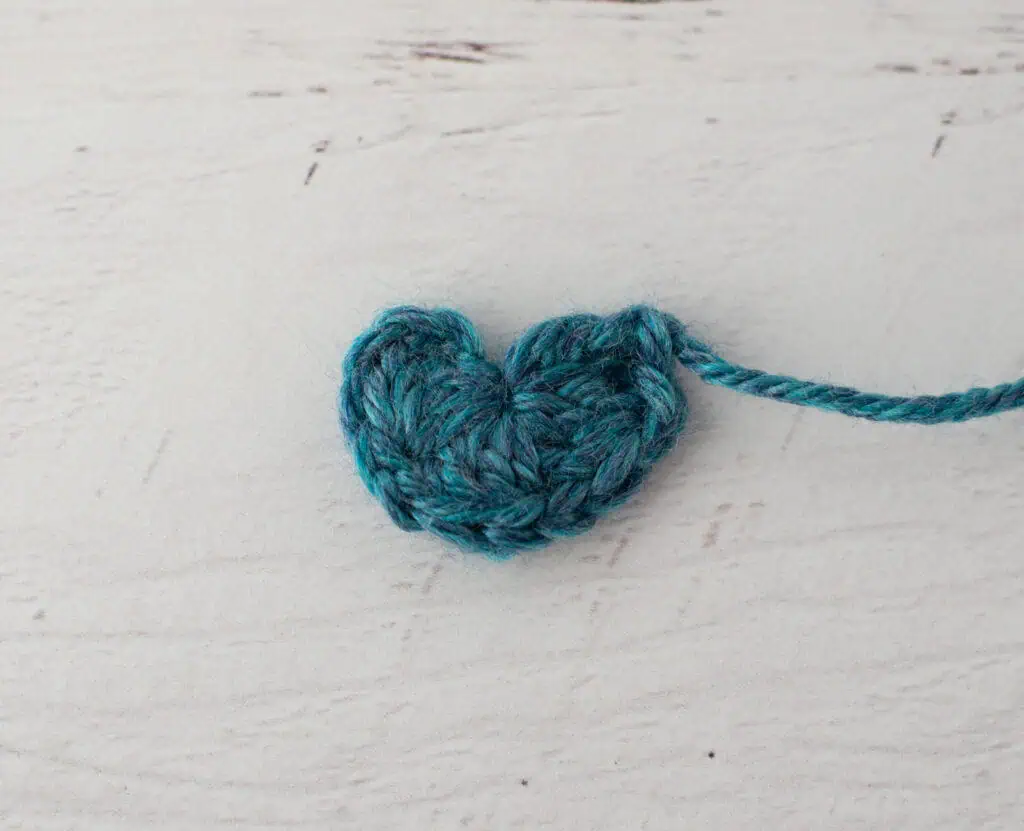
R1: Work all in the magic ring: Ch 4, [(3dcc, ch 1)] 3 times, then dc. Do not join. Pull magic ring closed but keep work in a half circle/crescent shape. Fasten off.(6 clusters)
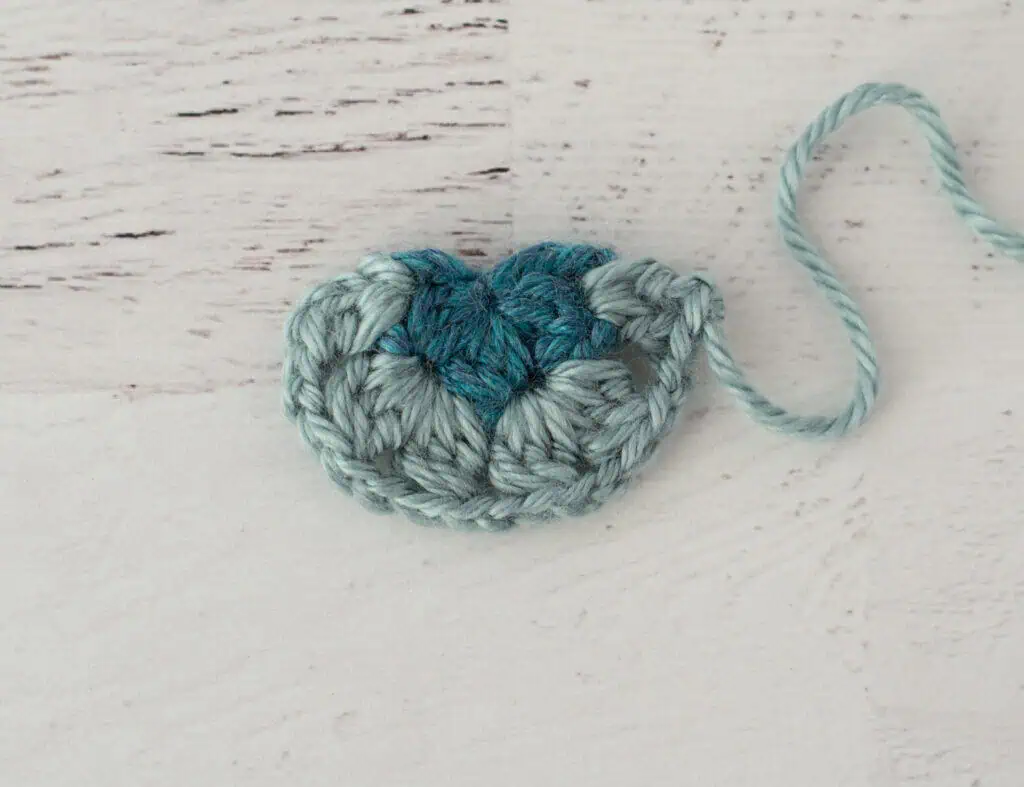
R2: Join color 2 to the space between the ch-4 and first 3dcc of the prior row. Then, (ch 3, dc, ch 2) in same space, (3dcc, ch 2, 3dcc, ch 2) in each of the next 2 ch-1 spaces, then work 2dc in the last ch-1 space. Fasten off.
How To Join A Hexagon As You Go
Follow the diagram for the afghan (365-day or 366-day layout) to determine where to join hexagons. The tutorial shows how to work a join on 3 sides. However, you may only be joining on 2 sides, depending on the location of the hexagon in the blanket.
This is how the hexagon looks after rounds 1 and 2. Refer back to the instructions for round 3 which we will use to join-as-you-go.
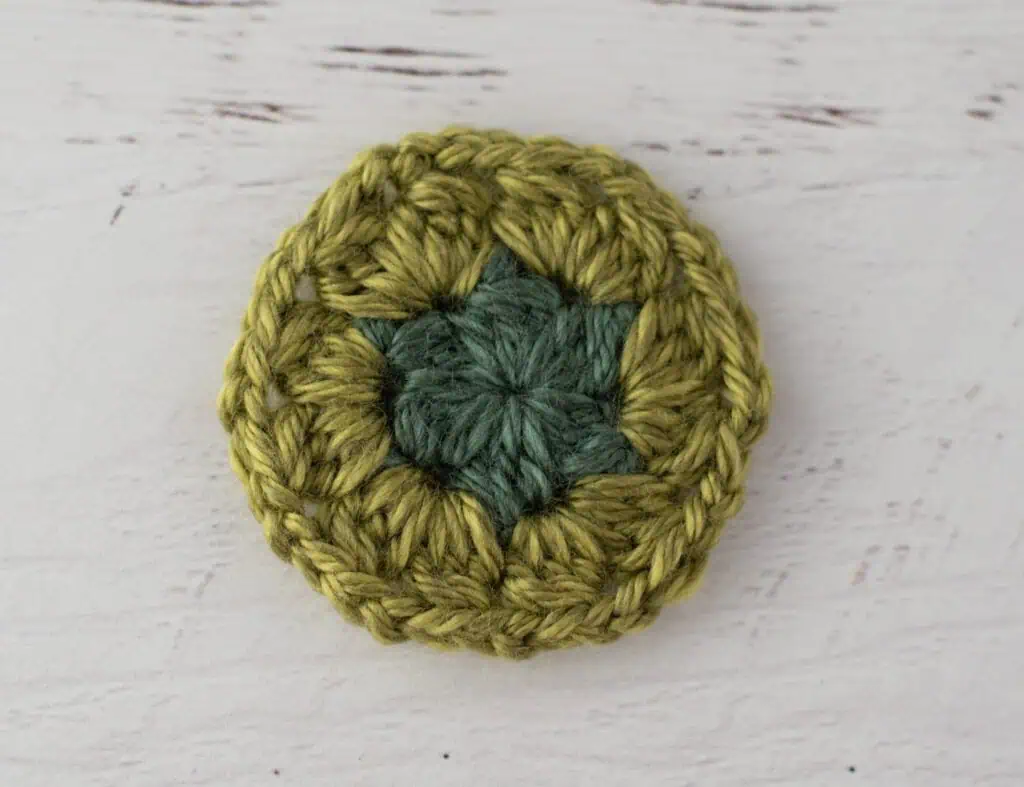
Step 1: Using the hexagon round 3 directions, work the first 2 sides of hexagon, starting with the first corner then working the first side and second corner. When you come to the 3rd corner, work 2dc and chain 1.
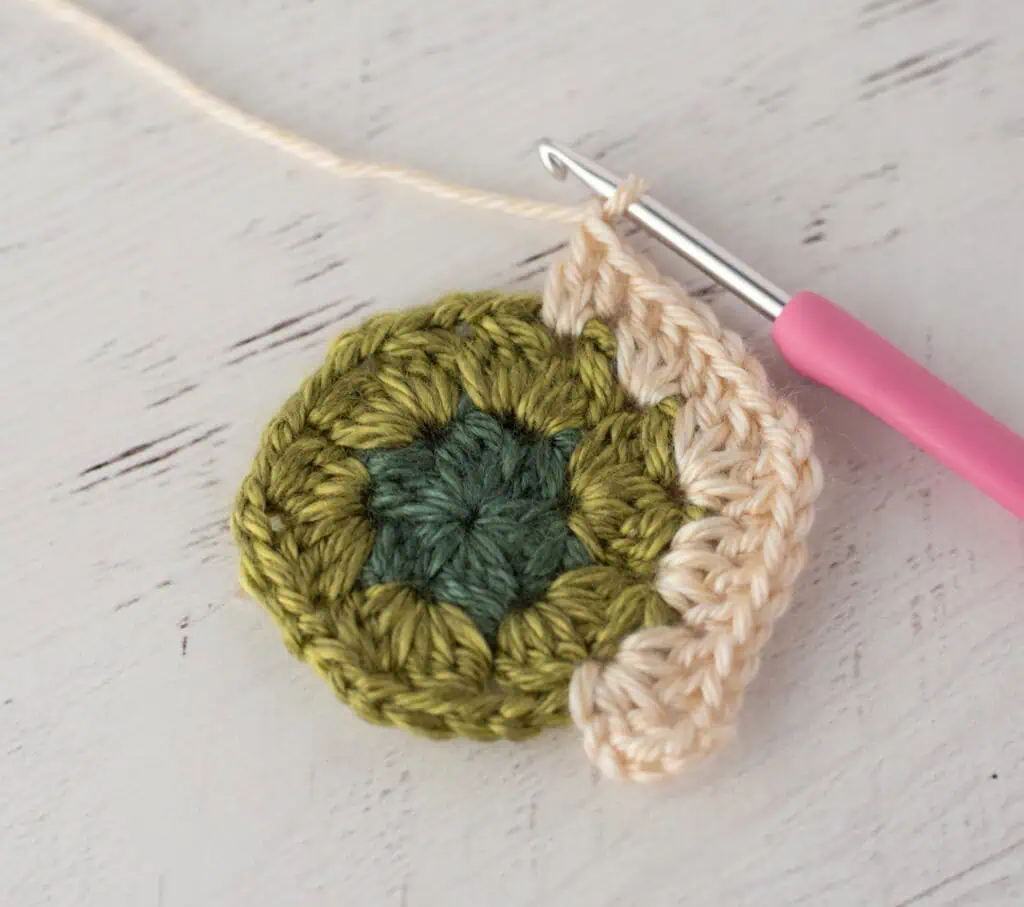
Step 2: Take your hook out of your work and re-insert it into the corner of the hexagon on the blanket.
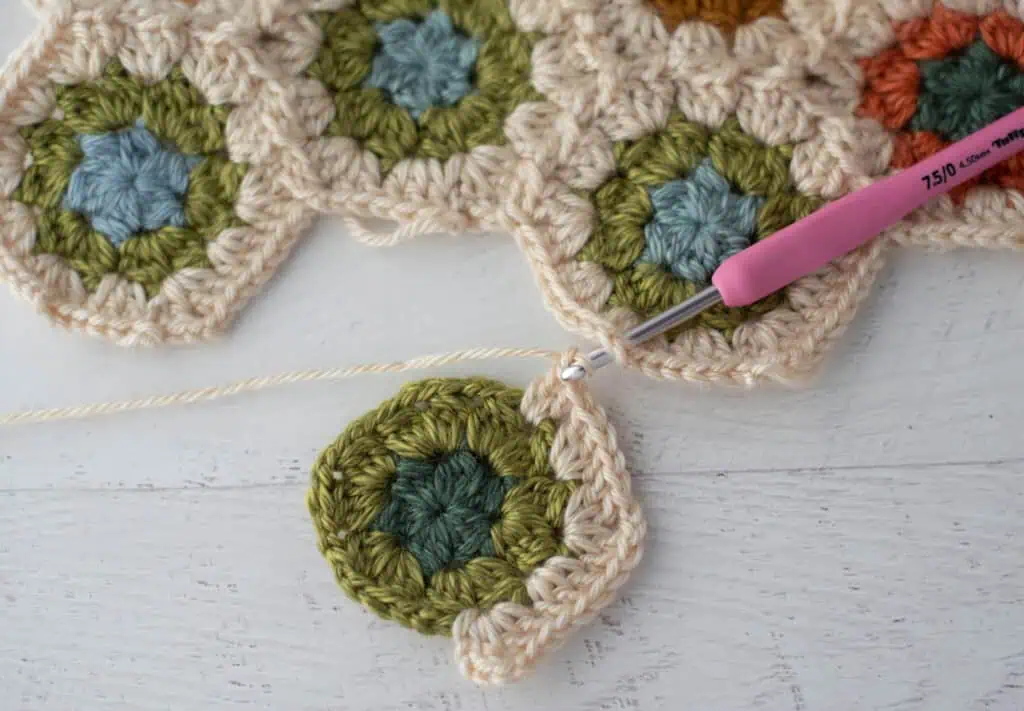
Step 3: Pull the loop through the corner and chain 1.
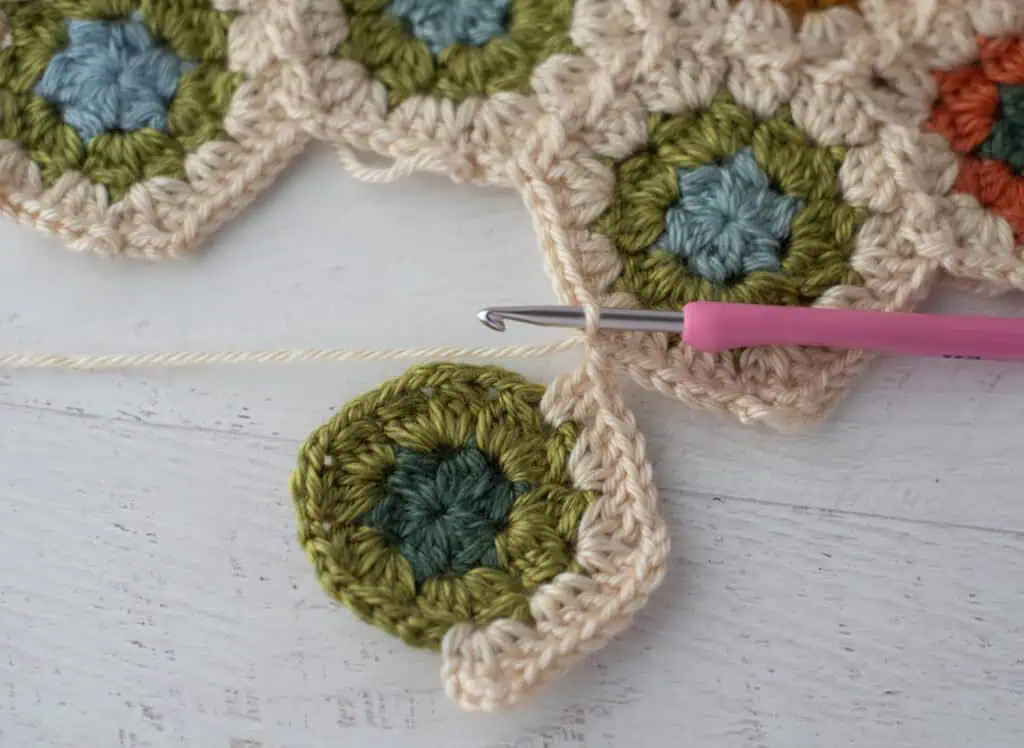
Step 4: Work the remaining 2 dc in the corner of the new hexagon.
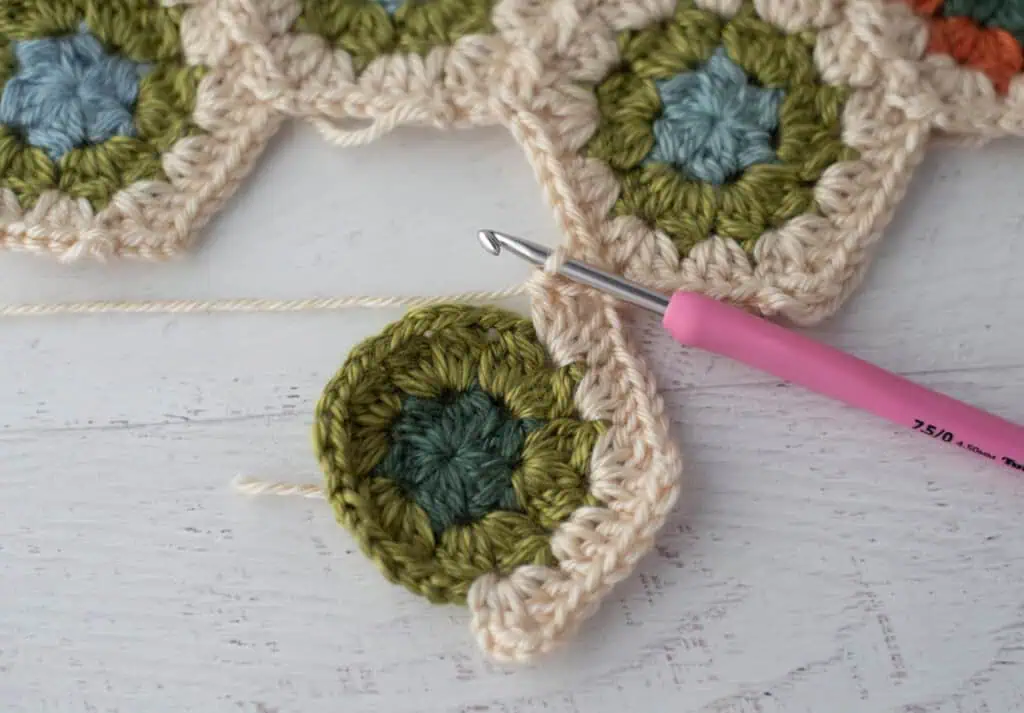
Step 5: Remove hook and pull loop through the space between the last 2 dc of the corner and 3 dc on the corresponding hexagon. (Do NOT chain)
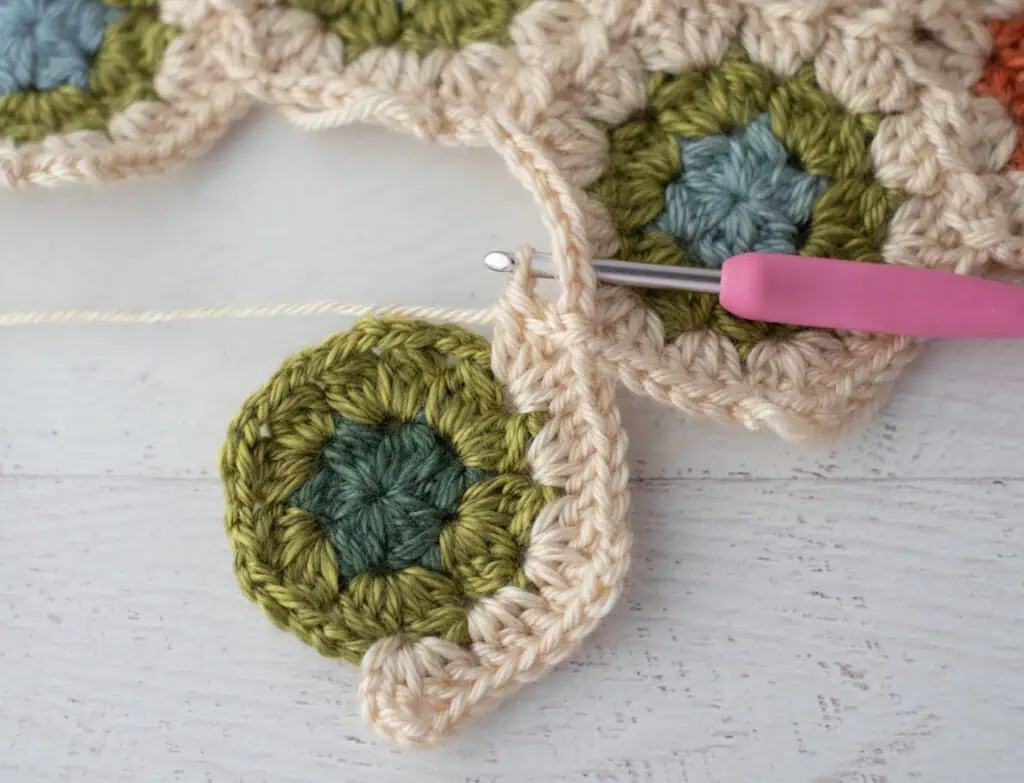
Step 6: Work 3 dc in the next space on the new hexagon
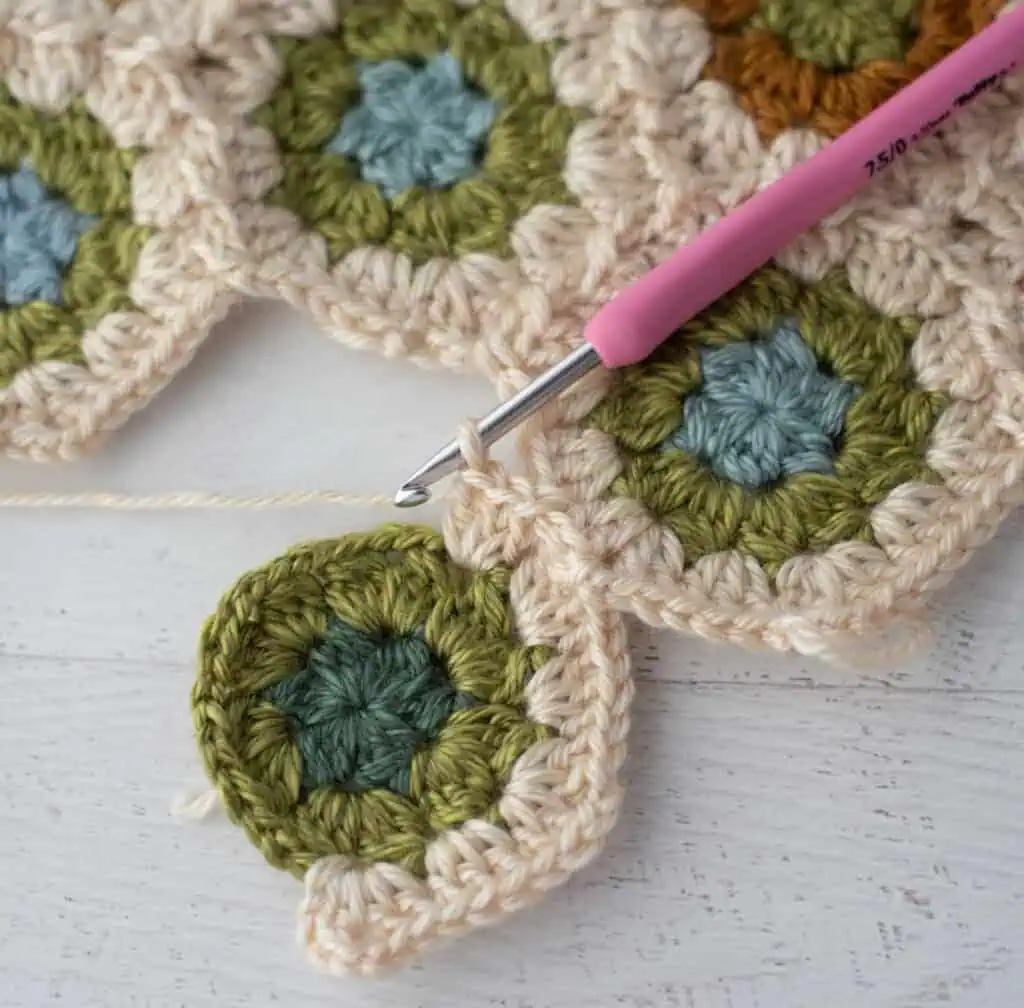
Step 7: Similarly, remove the hook, pull through the next space on the hexagon on the blanket. Then work 2 dc and ch 1 for the next corner on the new hexagon.
Step 8: The next joining point connects 3 corners: the corner on the new hexagon and 2 corners on the blanket. Remove hook and insert hook into the 2 corners of the blanket hexagons and pull the loop through and chain 1.
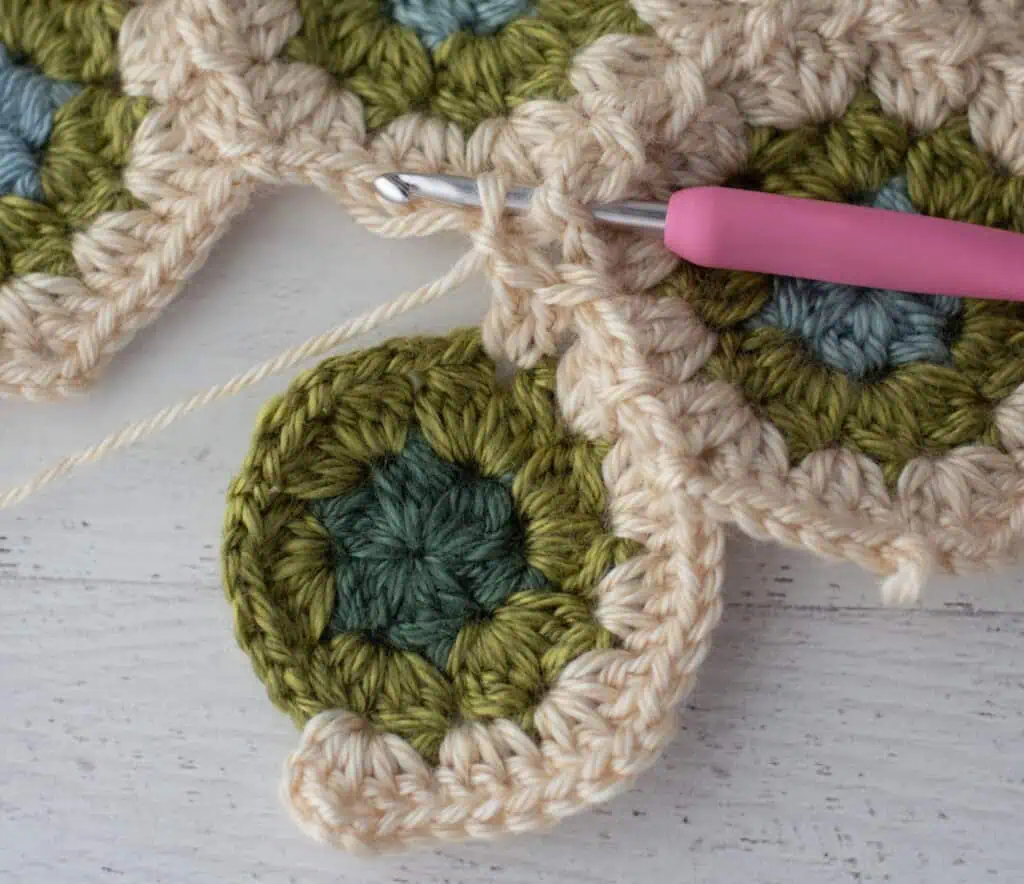
Continue to work around in the established pattern to attach the hexagon to the adjoining hexagons, working 3dc stitches on the sides with 3dc stitches (with no additional chains at the connecting point) and the corners by working half the corner and a chain 1, then dropping the hook and pulling through the corresponding corner, and making the 2nd chain before working the other half of the corner on the new hexagon.
When all the sides that connect are joined, work the remainder of R3 on the new hexagon as directed in the pattern, joining at the end with a slip stitch to the top of the starting ch-3.
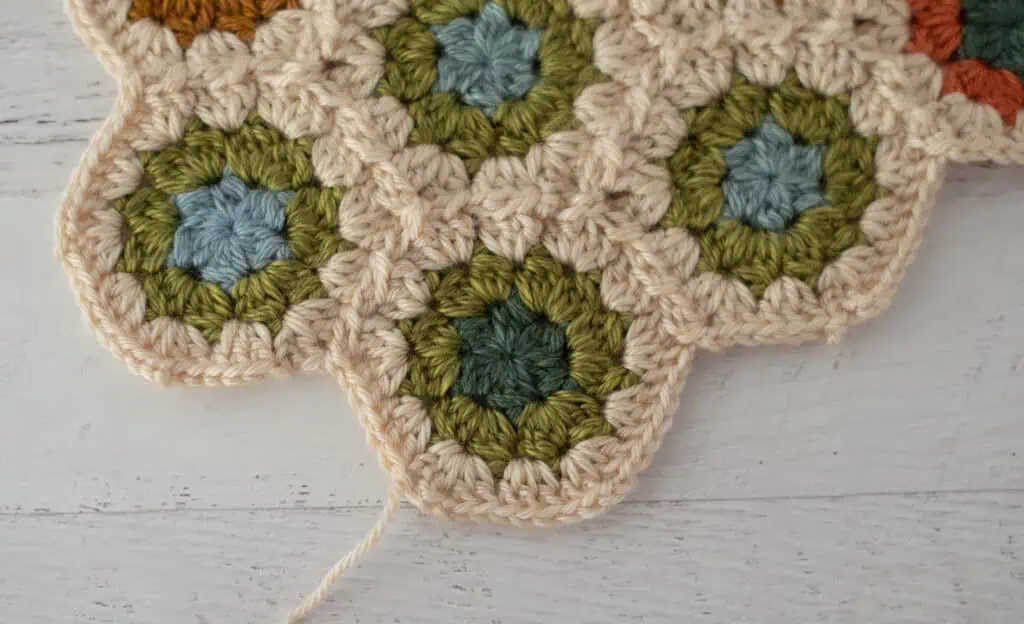
How to Join a Half Hexagon As You Go
Half hexagons are joined similarly to hexagons. Remember the only rows that are comprised of half hexagons are row 1 and the final row. The first row of half hexagons will be attached after rows 2 and 3 are joined:
Step1: Join yarn with a slip stitch to the corresponding outside corner of hex at end of row on blanket (see photo).
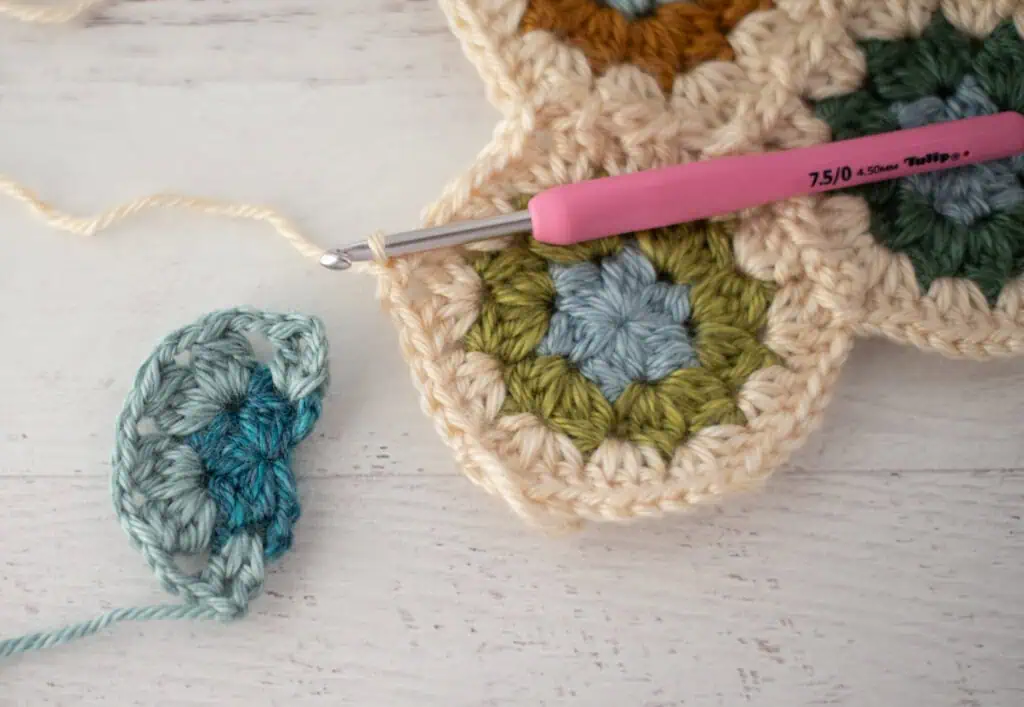
Step 2: Work 2dc in between the first 2 dc on the half hexagon. This represents half of a corner.
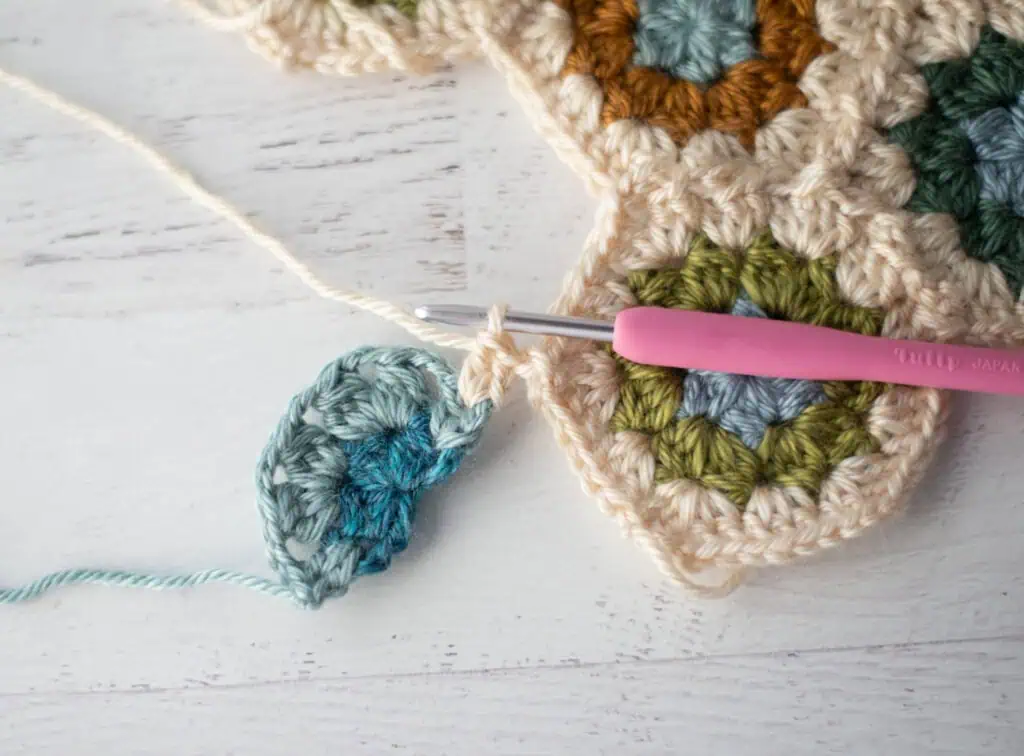
Step 3: Remove hook and pull loop through the space between the last 2 dc of the corner and 3 dc on the corresponding hexagon. (Do NOT chain)
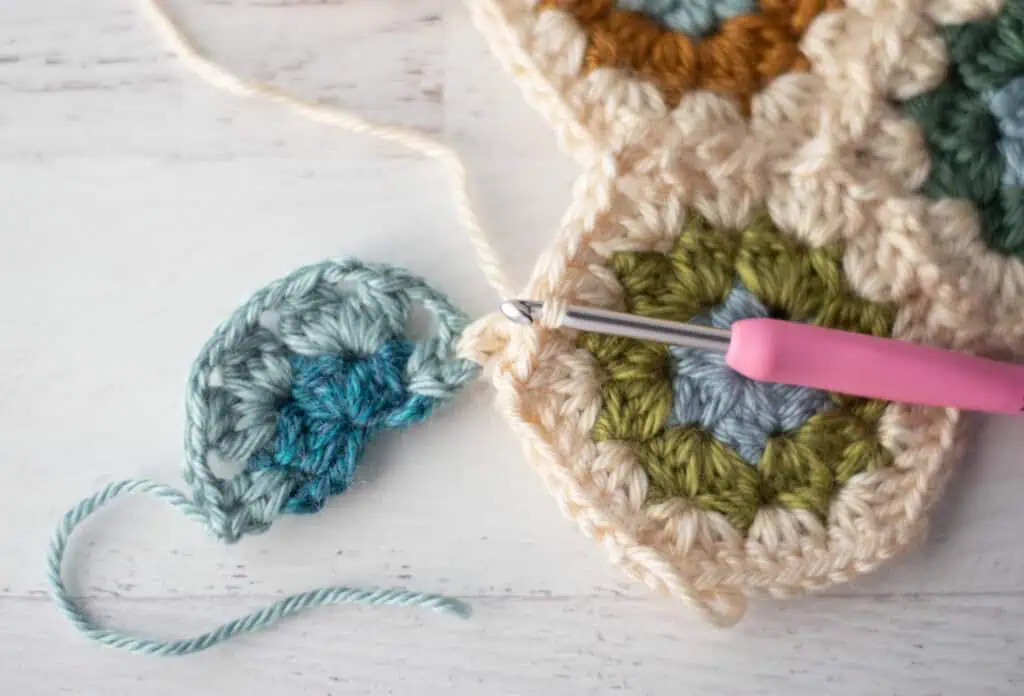
Step 4: Continue to join as you go in a similar manner as joining a full hexagon, making sure to attach 3 corners together when joining to 2 hexagons.
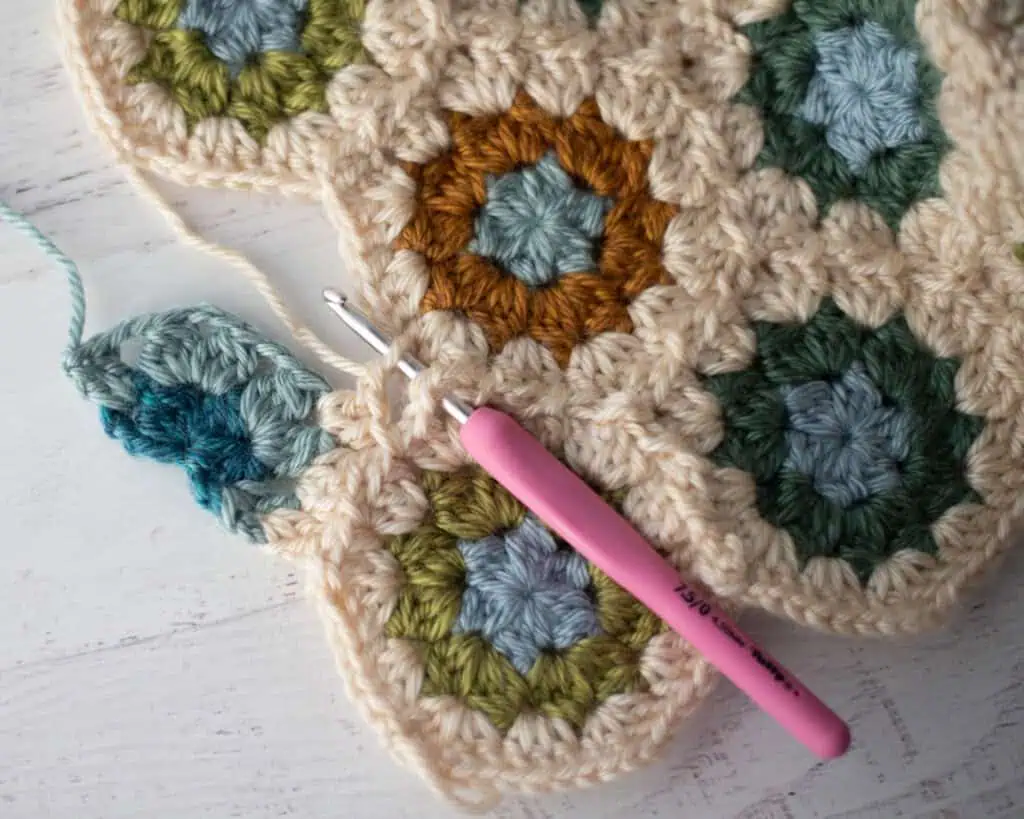
And here’s a photo after the 2nd 3-corner join:
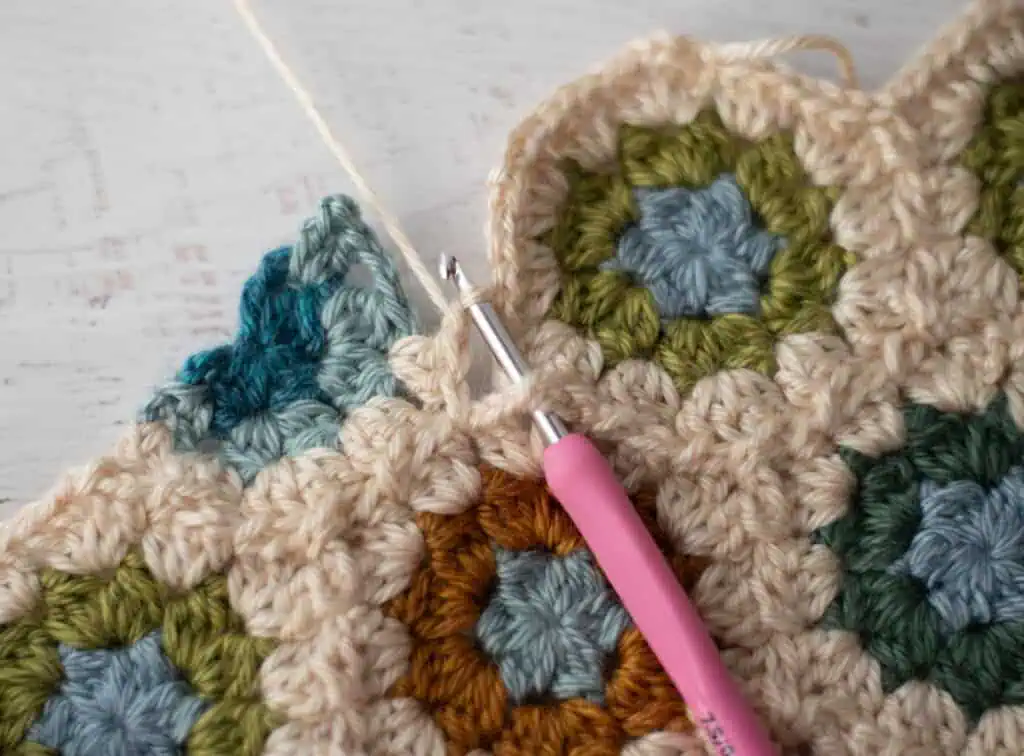
Step 5: To finish, work 2 dc between the 2dc on the half hexagon.
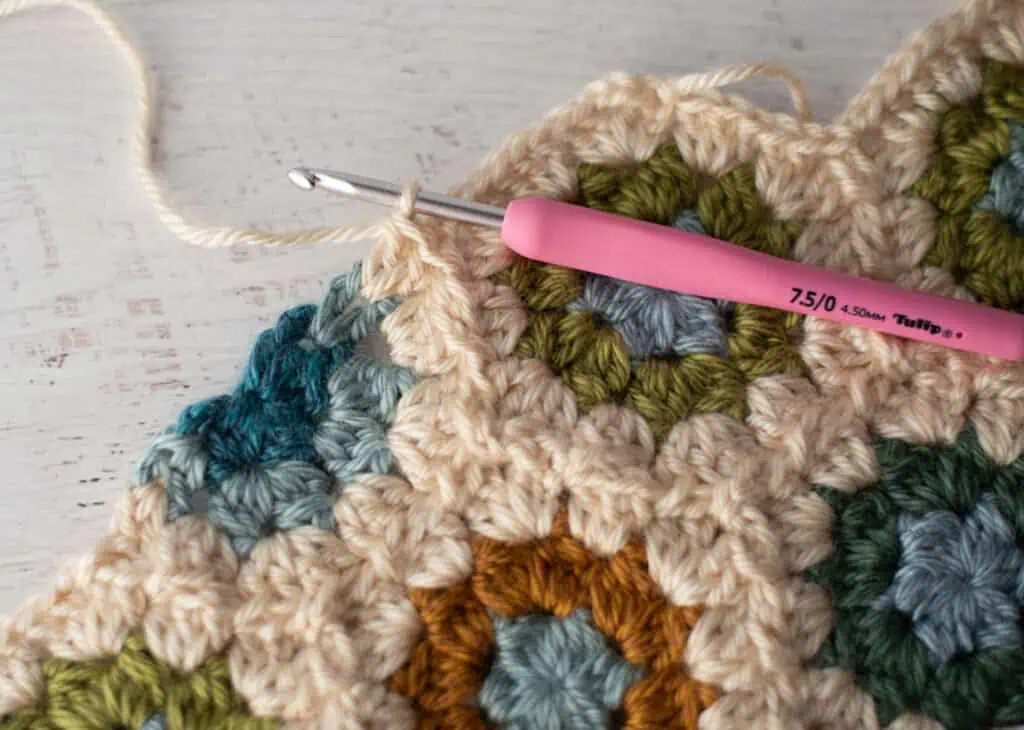
Then drop the hook and pull through the corner space on the blanket and slip stitch to join. Fasten off.
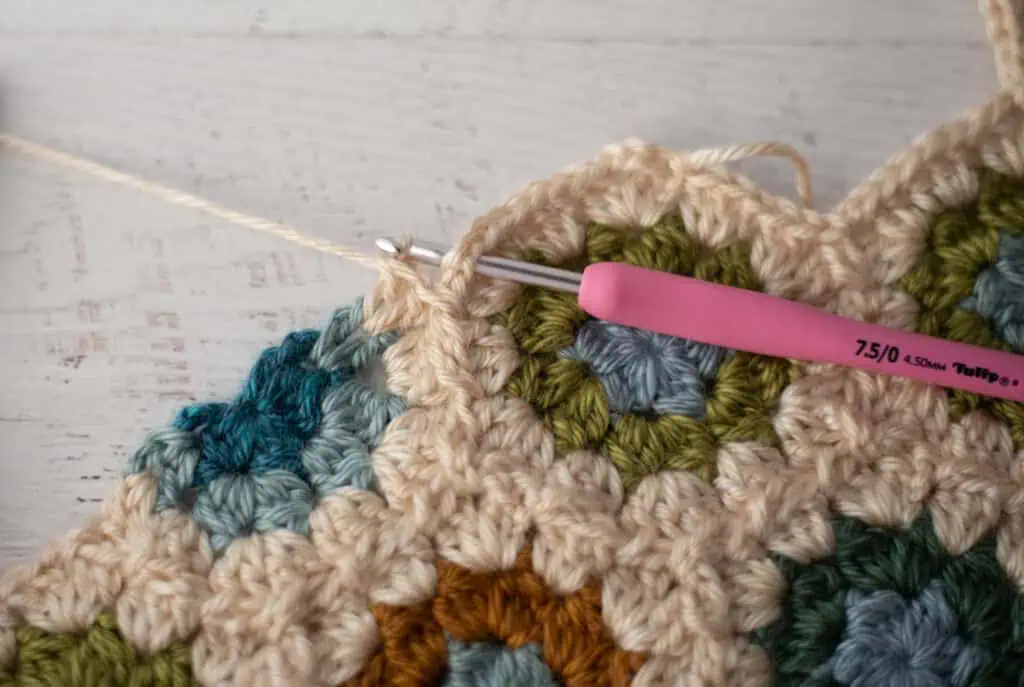
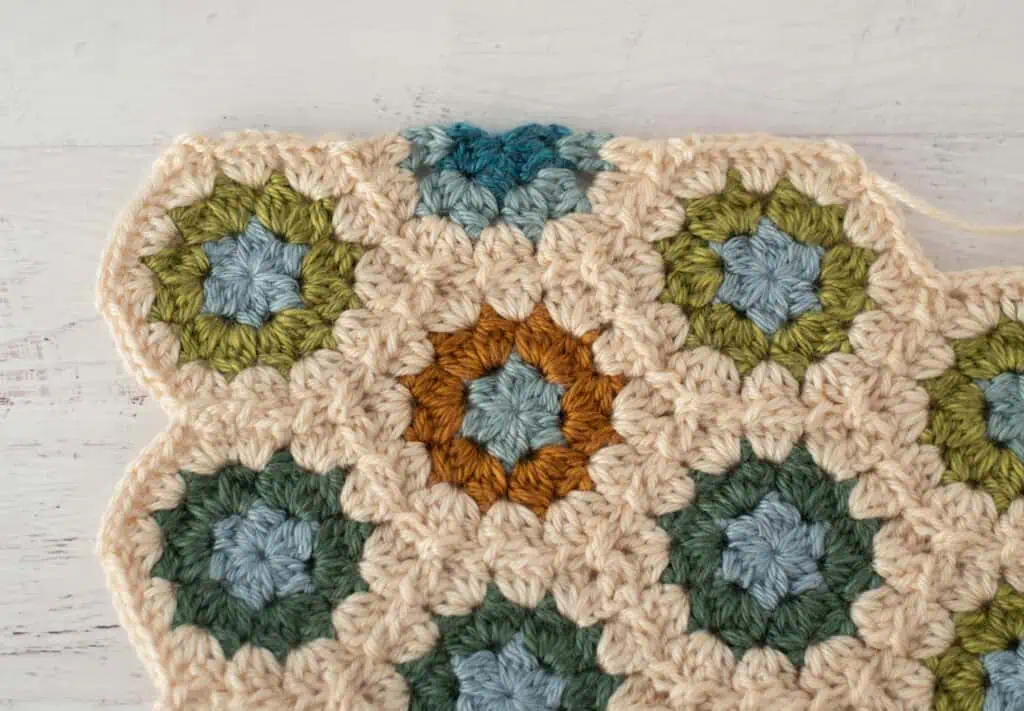
This is how the half hexagon looks when joined to the afghan:
Finishing the Temperature Blanket
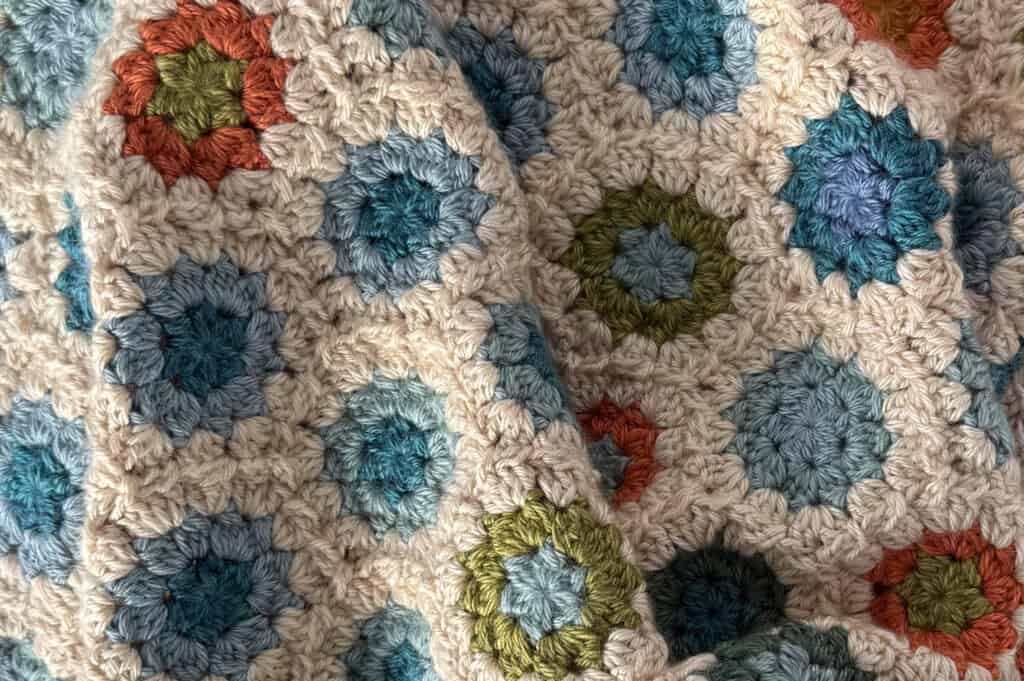
This hexagon style afghan creates a lot of ends that need to be woven in. Here is how I handle that: I weave in the ends from R1 and R2 as I work the hexagons and half hexagons. After I join a row or two, I go back and weave in the ends.
Border
For my afghan, I decided to leave it as is, with NO border. Here’s why: I really like the look of the scalloped side edges that form as the hexagons are joined. I also like the half hexagons at the top and I felt that a row of the cream color on top of that would disrupt that. However, you may feel differently.
If you’d like a border, here are a few tips: If you’d like to work a row or two of single crochet around, take care to evenly space single crochet stitches across the top and bottom of your blanket, checking every few stitches to make sure the blanket is not ruffling from too many stitches or pulling in from two few stitches. On the scalloped edge, work 2 stitches into each hexagon point and decrease 2 stitches over every spot where the 2 hexagons meet.
If you do decide to do a border, you will need additional yarn as that is not included in the materials given.
Want to crochet even more afghan patterns? Be sure to check out my collection of free crochet blanket patterns.
I love seeing your finished projects! If you enjoyed making this Crochet Temperature Blanket pattern, I’d love to see yours on Instagram, be sure to tag me @crochet365knittoo. If you are on Facebook, stop over to the Crochet 365 Knit Too Facebook page or pop over to the Crochet365KnitToo Club and share a photo! I’d love to see your work!